
About the prototype
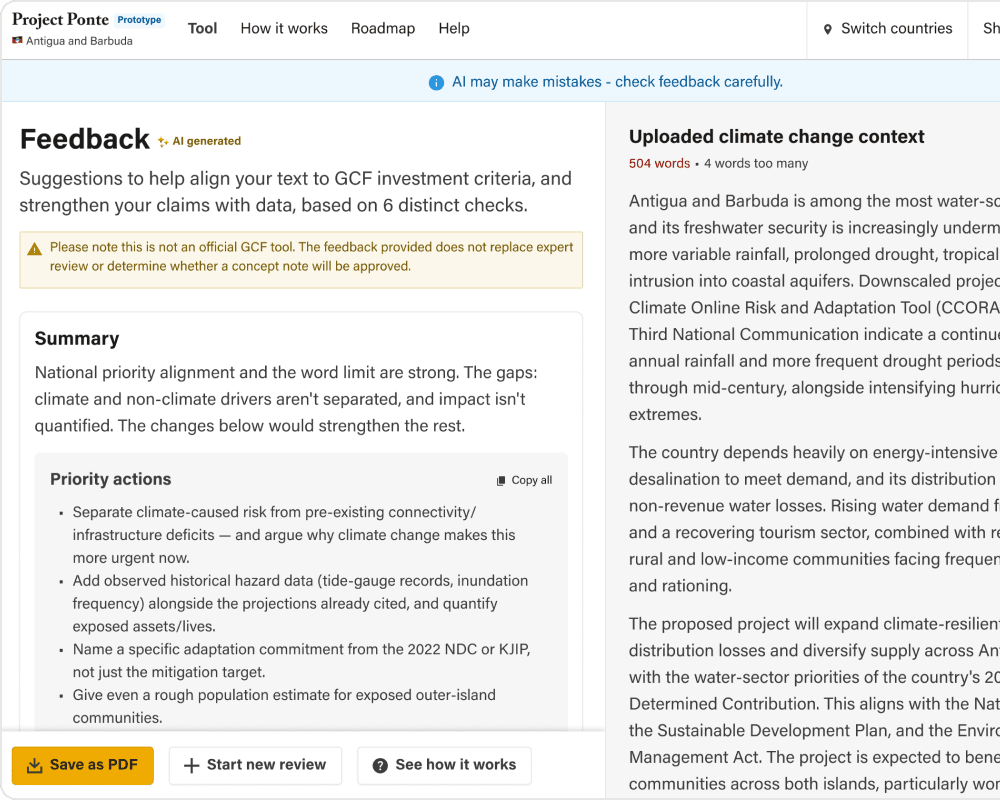
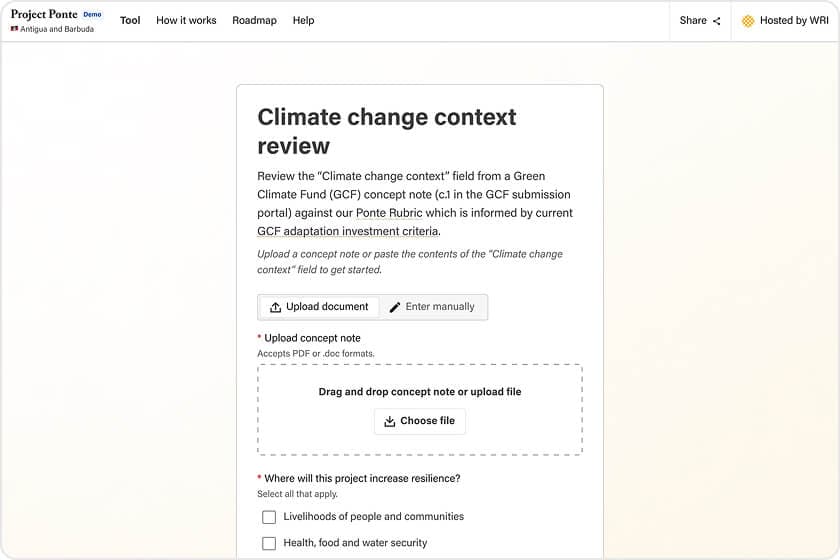
The prototype reviews the Climate Change Context section of Green Climate Fund (GCF) adaptation-focused Project Concept Notes.
It provides structured feedback against key GCF expectations, helping users identify gaps, strengthen the climate change context portion of their climate rationale, and improve draft quality before submission.
The prototype is currently available for four pilot countries: Antigua and Barbuda, Fiji, Cambodia and Cabo Verde, while the Public Demo is available for anyone to try - using an example Project Concept Note to showcase the tool.
How does the prototype work?
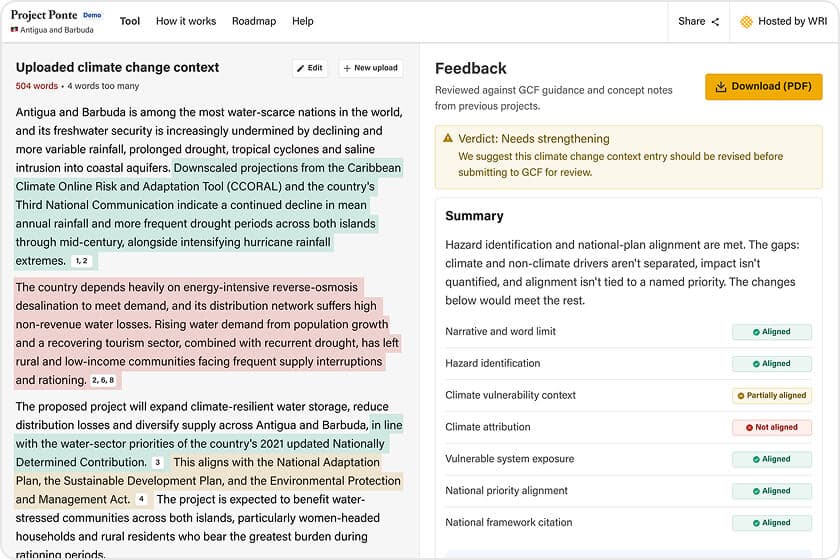
The prototype assesses the draft against a defined set of internal criteria derived from GCF guidance and relevant country-level documents such as Nationally Determined Contribution (NDC), National Adaptation Plan (NAP) and National Communications submitted to the UNFCCC.
The feedback is organized by clear themes, including: hazard identification, climate vulnerability, climate attribution, system exposure and alignment with national priorities. Each theme is given a red, amber or green status, alongside an explanation and practical suggestions for improvement.
The scope of the prototype
The aim of the current prototype is to help us learn how to refine the use of AI to provide reliable and useful outputs. We are exploring how to expand this work, dependent on successful fundraising, including to:
- Extend to full Concept Notes beyond the Climate Change Context section.
- Review Concept Notes and provide feedback in additional languages.
- Include Concept Notes for both adaptation and mitigation projects.
- Support applications to other climate funds.
- Collaboration features to support teams to work together.
- Provide additional tools to support before and after Concept Note writing.
Funding our work
About Project Ponte
Project Ponte is a pilot initiative by World Resources Institute (WRI) and the NDC Partnership exploring how AI can improve access to climate finance for Least Developed Countries (LDCs) and Small Island Developing States (SIDS). This work has been made possible by support from the Netherlands and collaboration and input from the GCF and several LDCs and SIDS countries.
An AI-powered tool, developed with buy-in from countries could simplify and accelerate the early proposal drafting process, directly supporting LDCs, SIDS, and other vulnerable countries in accessing urgently needed finance for climate.
We're currently partnering with pilot countries to develop a prototype that reviews GCF Project Concept Notes. This includes regular user research and feedback to ensure it solves real challenges faced by teams preparing climate finance applications.
Our latest review criteria
The prototype reviews against a set of criteria that both humans and AI models can easily understand to translate GCF policies into a red, amber, or green status.
Checks whether the relevant climate hazard or climatic driver is clearly identified in the climate change context.
No relevant climate hazard or climatic driver is identifiable from C.1.
A climate-related physical condition is present, but the hazard or driver remains vague, ambiguous or cannot be distinguished reliably.
The relevant climate hazard or climatic driver is clearly identifiable in C.1.
Assesses whether the historical or current climate context, forward-looking climate basis, and resulting risk or impact pathway are clearly connected.
Assesses how climate change contributes, or is expected to contribute, to the risk or impact and, where material, how non-climatic drivers interact with it.
Assesses who or what is exposed, where or in what setting the exposure occurs, and how it relates to the climate hazard or driver. Where relevant, it also considers vulnerability.
Assesses whether the proposed activity is clearly linked to a relevant national framework, priority or commitment in the configured country sources.
Where are we now?
A timeline of the research and development completed as part of Project Ponte since it was formally established in late 2025.
Established Project Ponte
World Resources Institute and NDC Partnership identified the need to support Least Developed Countries and Small Island Developing States to access climate finance and collaborated to form the initiative.
Assessed country needs
Convened a working group of representatives of Least Developed Countries and Small Island Developing States to conduct research sessions and identify the needs and challenges countries have faced when accessing climate finance.
Designed the Ponte Rubric
Translated existing Green Climate Fund (GCF) documentation, including policies and guidance, into an open-source rubric that both humans and AI models can easily understand.
Built the demo tool
Developed a tool that can be tested with pilot countries to gather feedback, and showcase how AI models can be guided to provide reliable outputs.
Piloting the demo tool and fundraising for future expansions
Deploying the demo tool for use by pilot countries and partners, and taking learnings from this work to identify priorities for future features, while raising funds to support potential future expansions of the tool.
Help us shape the future of Project Ponte
We need your support to define what we focus on next.
Try the demo
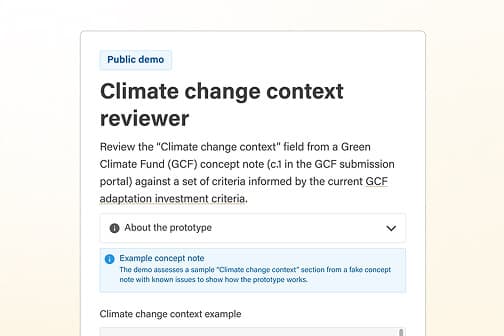
You can try out the public demo with no account. It showcases how the tool works and what feedback you can expect using an example Concept Note.
Vote on future features
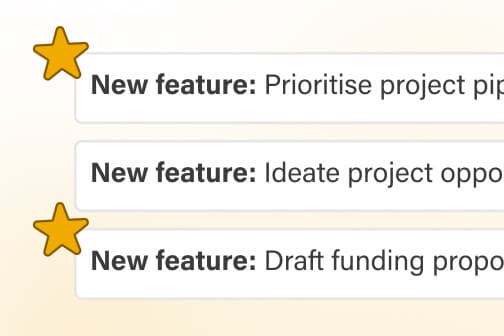
We'd love your input to help shape the future of Project Ponte. Take our survey to have your say on what we focus on building next.
Join the pilot
If your country is not part of our pilot test yet, please request to join (currently only accepting LDC and SIDS), and we will be in touch about extending the prototype to your country.
Frequently asked questions
Answers to common questions we’ve received about the prototype.
1. Who is Project Ponte for?
This prototype was built to support National Designated Authorities (NDAs) and focal points in Least Developed Countries (LDCs) and Small Island Developing States (SIDS) in refining draft Project Concept Notes for the Green Climate Fund (GCF).
Developing countries face significant challenges in accessing climate finance at scale to advance their climate goals. The process to accessing finance from climate funds can be long and complex, and these challenges are exacerbated for LDCs and SIDs, who often have limited capacity to devote to these processes and face other barriers. Project Ponte’s artificial intelligence-enabled aims to directly support LDCs and SIDS in refining project Concept Notes faster, in order to accelerate this process.
2. Which countries does Project Ponte currently support?
The prototype currently supports the following countries: Antigua and Barbuda, Cabo Verde, Cambodia, and Fiji. Future versions of the tool are expected to expand the number of countries supported. If you are interested in adding your country to the list of Project Ponte prototype, please have your NDC Partnership Focal Point or GCF National Designated Authority (NDA) contact the Project Ponte team.
3. Which partners built Project Ponte?
Project Ponte was built and is managed by teams from the NDC Partnership Support Unit and the World Resources Institute (WRI) Data Lab, with support from the Netherlands and collaboration and input from the Green Climate Fund (GCF) as well as several LDCs and SIDS countries and other partners.
Project Ponte is grateful to the following countries and partners who have contributed to the inputs, design, or testing for the prototype tool: Antigua and Barbuda, Belize, Cabo Verde, Cambodia, Fiji, Jamaica, Mauritius, Rwanda, Somalia, Benin, Haiti, Mali, Madagascar, Nepal, the Commonwealth Secretariat, and the Climate Finance Access Network (CFAN).
4. How does Project Ponte differ from the GCF Partner Portal and GCF review processes?
Project Ponte is an experimental demo designed to support learning and testing. It is not connected to the GCF Partner Portal, and it is not possible to officially submit a Project Concept Note to the GCF via this tool. All official Concept Note submissions must take place via the GCF Partner Portal.
Use of Project Ponte does not constitute an official review of a Concept Note by the GCF. While it may be helpful, the use of this tool is also not required in advance of Concept Note submission to the GCF. Use of the Project Ponte tool does not mean that a Concept Note will be approved by the NDA or GCF, nor does it mean that the associated project will ultimately be funded by the GCF.
5. Which section(s) of the Concept Note does the review cover?
Project Ponte currently reviews only section C.1, the climate change context section of the Green Climate Fund’s Project Concept Note template. The prototype does not assess other sections of the Concept Note, other GCF templates, or the proposal as a whole. Future versions may include additional sections or functionality.
6. Is Project Ponte a replacement for a technical consultant or Accredited Entity review?
No. Project Ponte is an experimental prototype designed to provide an additional diagnostic review of one part of a GCF Project Concept Note. It does not replace expert review, Accredited Entity due diligence, or any formal review by the NDA or GCF.
The tool highlights areas of the C.1 climate change context that may merit further attention as the draft is refined. It does not draft or rewrite the Concept Note, approve content, determine whether a Concept Note is ready for submission, or predict whether a project will ultimately be approved or funded.
7. Is this tool publicly available, or limited to pilot partners?
Project Ponte is currently being tested with a small number of LDC and SIDS partner countries and is not generally available for unrestricted use.
During the pilot, access to country-specific versions is organized through participating countries. NDAs and focal points may involve Accredited Entities, consultants, or other partners supporting their Concept Note development.
If your country is interested in participating in Project Ponte, please contact the Project Ponte team at projectponte@wri.org.
8. How does Project Ponte work? What is the role of artificial intelligence (AI) in Project Ponte?
Project Ponte is a large language model to review the climate change context presented in section C.1 of a draft GCF Project Concept Note.
The tool assesses whether the C.1 narrative establishes a coherent climate-risk pathway. In particular, it considers whether the relevant climate hazard or driver is clearly identified, whether the climate context and resulting risk or impact pathway can be followed, how climate change contributes to the risk, and who or what is exposed or vulnerable.
Project Ponte also reviews the apparent support for material factual claims using the citation and reference information visible in the submitted C.1 text. This evidence check is separate from the assessment of the narrative itself.
For country-specific prototypes, selected national documents are also configured in the tool for specific purposes, including interpretation of national climate terminology where relevant and assessment of national-priority alignment.
Project Ponte does not search the open internet as part of the review, independently verify the full contents of every cited source, rewrite the Concept Note, or make an official GCF assessment. Its findings are diagnostic prompts for the user’s consideration and may occasionally miss or misinterpret relevant context.
9. What happens to the Concept Note text I upload or paste in? Is it stored?
Project Ponte does not retain the Concept Note text you submit by default. A user must opt-in by selecting the check box “I allow data uploaded to be stored and used to help future development of this tool.” If this box remains unchecked, no one from the Project Ponte team will be able to access the text you uploaded. If you check the box and opt-in, the data will be securely stored by the Project Ponte team and will only be used to improve the tool. This raw data will not be shared with external users nor with the GCF.
10. Does Project Ponte use my content to train public AI models?
No. Project Ponte runs on WRI's enterprise AI contract, which excludes the use of submitted content for public model training. Our agreement with AI model providers prevents them from seeing your data and we keep your data on a private repository. Project Ponte is subject to WRI’s robust internal guidelines on the responsible use of artificial intelligence. For more about AI use at WRI, see here.
11. Can my country's material be seen by or used to help other countries?
At this stage in the testing process, by default, your country-specific materials are not shared across countries. If you choose to opt-in to data storing, this is limited to internal use to improve our model performance for LDC and SIDS countries using Project Ponte.
The C.1 content you provide will not be shared with any other countries, unrelated consultants or GCF reviewers.
If you're still concerned, you may provide a fake-but-approximate version of the C.1 text that you would still find valuable to test the tool.
12. What if my Concept Note contains sensitive or confidential information?
Project Ponte is designed with the assumption that Concept Note content may be sensitive, and handles it accordingly. We recommend not including any information beyond what you'd typically include in a GCF submission.
13. How does Project Ponte decide something is a "gap"? What sources does it check against?
Project Ponte reviews the C.1 text to identify whether the key elements needed to explain the climate-risk pathway are present and sufficiently clear. It also checks material factual claims against the citation and reference information visible in the submitted C.1 text.
For evidence, the tool indicates whether a visible reference appears relevant, should be verified, is not visible, or whether an evidence check is not applicable. It does not open and verify every cited source.
Country-specific versions also use a configured set of national documents for defined functions, including national-priority alignment and, where relevant, interpretation of country-specific climate terminology.
A potential gap does not necessarily mean that information or evidence does not exist. Relevant information may appear elsewhere in the Concept Note or in sources that Project Ponte does not have access to.
14. Why might Project Ponte flag something as missing when I know it's covered elsewhere in the CN?
Project Ponte currently reviews only section C.1. It therefore may not detect information that appears elsewhere in the Concept Note.
If a finding relates to information that you know is adequately addressed in another section, the user is free to apply their own judgement. The tool is designed to identify possible gaps within the C.1 text it reviews, rather than make a definitive assessment of the Concept Note as a whole.
15. Does Project Ponte understand my country's specific context, or is it using generic climate data?
Country-specific versions of Project Ponte use a configured set of authoritative national documents for defined parts of the assessment.
These include the country’s NDC, NAP/NAPA or equivalent adaptation planning document, and an additional authoritative national strategy or priority document, as available. The tool may use selected national climate information to help interpret terminology already present in the C.1 text and uses the configured country documents to assess national-priority alignment.
If you would like Project Ponte to consider additional data or documentation as context in future versions of the tool, please submit documentation here: link to join the pilot.
16. What's the red/amber/green scoring based on, and what should I do with an amber/red flag?
Project Ponte uses a simple red/amber/green diagnostic to show how clearly the C.1 climate change context addresses key elements reflected in GCF guidance and the relevant GCF investment criteria, including the Investment Framework for GCF-2.
Green means the climate-risk narrative is clear and coherent for the element being reviewed.
Amber means the main climate-risk relationship is clear, with some targeted clarification or additional detail that could strengthen the C.1 narrative.
Red means that a core element needs further development for the climate-risk relationship to be clearly followed.
Project Ponte also looks separately at the support for material factual claims and at alignment with national priorities. This helps distinguish whether further refinement would be most useful in the narrative itself, in the supporting evidence, or in explaining the link to country priorities.
Amber and red findings are therefore practical prompts showing where targeted improvements could strengthen the C.1 section.
17. Can Ponte make mistakes? What should I do if I disagree with a review?
Yes. Project Ponte is an AI-assisted diagnostic tool and may miss context, misunderstand wording, or make an incorrect judgement.
Its findings are based only on the C.1 text, visible reference information, and the country-profile inputs configured for the prototype. If you disagree with a finding, you should apply your own judgement and, where appropriate, review the issue with colleagues, technical experts, or your Accredited Entity.
Feedback on findings that appear incorrect or unhelpful is particularly valuable during the pilot and will help the Project Ponte team improve the tool.
Project Ponte does not replace expert review and does not determine whether a Concept Note will be approved or ultimately funded.
18. Can multiple people on my team use the tool? Can they use it at the same time?
Yes multiple people on your team may have access to and use the Project Ponte prototype at the same time. We do not store sessions and the related content. You must download the review as a PDF in order to share with your team members.
19. Why are certain countries password protected? How do I access a country page?
During the pilot period, country pages may or may not be password protected. Please contact your country or partner colleagues participating in the testing of the prototype for the relevant password(s) or otherwise contact the Project Ponte team directly.
20. Do I have to pay to use the tool?
No. The Project Ponte prototype tool is freely available to a subset of LDCs and SIDS country users at no cost. Country-specific pages are only available for a subset of these countries.
21. What languages can Project Ponte support?
At present, Project Ponte is only able to receive and generate feedback in English, which is the official language of the Green Climate Fund. Future versions may allow for the possibility of content upload and reviews in other languages.
22. What is the difference between a country-specific prototype and the public demo?
The public demo is an open preview that anyone can try without signing in. It walks you through the same three steps as the real tool, showing a worked example based on a sample Concept Note, so you can see what the intake screen, the review process, and the feedback output look like. The content is fixed: the demo does not accept your own text, does not run a live review, and does not store anything you enter. The demo is not intended to support users who lack a dedicated country page.
A country-specific prototype is the working version of the tool, available to pilot countries and reached through a password-protected sign-in. It reviews the text you submit and is grounded in your country's own reference material, including national planning documents such as your Nationally Determined Contribution (NDC) and National Adaptation Plan (NAP), so the feedback reflects your national context rather than a generic example. Each pilot country has its own version, built once the necessary national documents are available.
If your country is not yet part of the pilot, you can use the public demo to see how the tool works and request to join the pilot from the same page.
23. How can I share feedback with the Project Ponte team about which features I would like to see added to future versions?
Click here to vote on future features. We'd love your input to help shape the future of Project Ponte. Take our survey to have your say on what we focus on building next.
24. Who do I contact with questions Ponte can't answer?
Please contact projectponte@wri.org with any further questions.